
Strandliners regularly undertakes citizen science microplastic monitoring at Camber Sands for Fidra, but it was on one such survey that we noticed the large quantities of bio-beads on the beach and alerted the Coastal Officers.
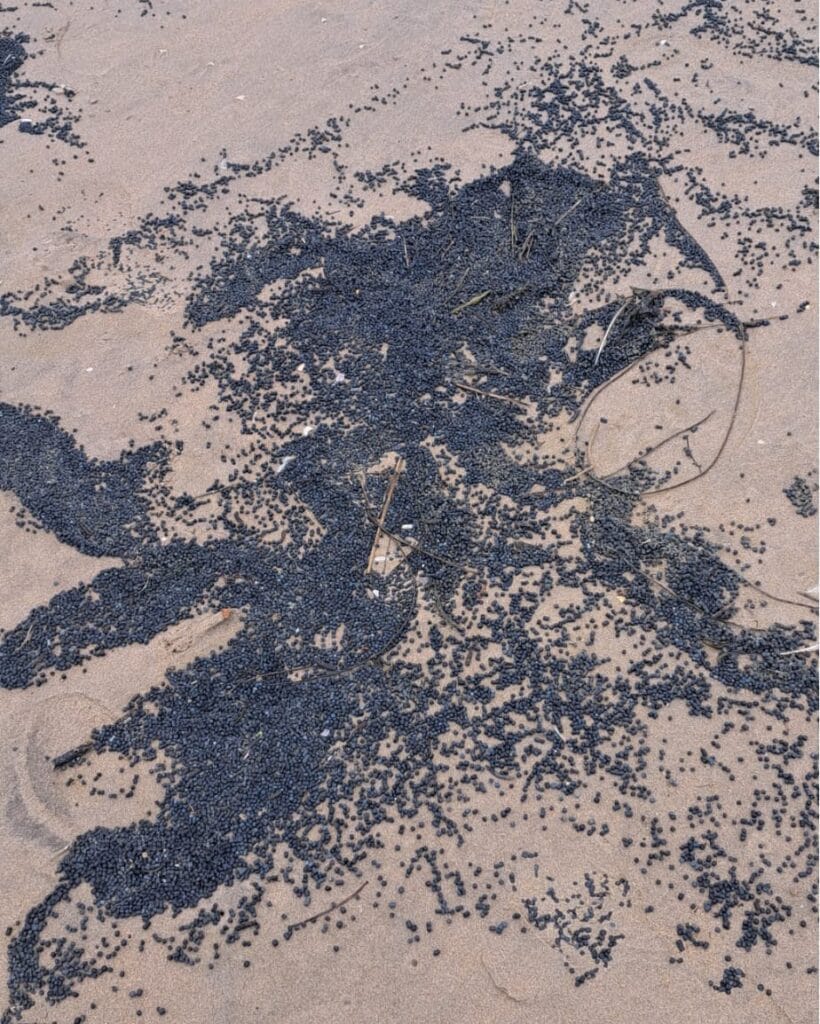
This is the worst plastic pellet pollution incident we have ever seen here at Camber. The impact on the environment and local wildlife can be catastrophic. Birds and marine animals easily mistake these toxic plastic pellets for food. Once ingested, it is difficult from them to expel the pellets, and they may either die of starvation or from the effects of the toxins they contain. Research has shown that microplastics such as industrial plastic pellets readily adsorb chemical toxins from the surrounding seawater: these toxins can be at concentrations thousands of times higher than the background water level.

What is a bio-bead?
Bio-beads are small plastic pellets used in wastewater treatment. They are a type of BAFF media (biological aerated flooded filter). Usually dark grey or black, they are ridged or crinkled to give a high surface area for bacteria (biofilm) to adhere to. Many of the BAFF plants were set up here in the early 1990s in response to new EU regulations on discharge. These were generally small-scale plants where there was not enough land for a traditional activated sludge system, or coastal plants that were visually sensitive. BAFF media also work in saline conditions. Before 2006, bio-beads were often made from post-consumer electronic waste, such as TVs and computers, and were possibly contaminated with toxic chemicals such as lead, antimony and bromine, used as flame retardants.
Southern Water, the company treating the wastewater in this region, has 3 sites that use bio-beads: Eastbourne, Broomfield Bank and Beckley.
There have been two major incidents reported to the Environment Agency (EA) where bio-beads were lost into the environment, in 2010 (you can read a report by the Cornish Plastic Pollution Coalition here), and 2017, when Strandliners assisted Rother District Council and a masters student from the University of Brighton in investigating the issue. You can read their report here. Unfortunately, Camber Sands seems to be a collecting hotspot for pellet pollution.
Where did the biobeads come from?
We know that there are two wastewater treatment plants nearby that use bio-beads: Eastbourne and Beckley. We know that Eastbourne Wastewater Treatment Works (WTW) suffered a ‘mechanical failure’ on Wednesday 22nd October, as reported by BBC News and started to spill during high tide just after 2am Thursday 23rd October.
Following investigation by Strandliners and MP for Hastings and Rye, Helena Dollimore, Southern Water has now admitted it is “highly likely” that millions of pellets ecaped onto Camber Sands over the weekend due to an issue at its Eastbourne wastewater site.
Helena Dollimore has been vital in our campaign to learn the truth, and has written to the CEO of Southern Water for answers. She says: “They [Southern Water] must answer why they didn’t investigate properly at the time and why has it taken our community to uncover this?“
Strandliners submitted an Environmental Information Request to Southern Water on 4th November. Souther Water has responded to one question, confirming they use bio-beads at the Eastbourne Wastewater Treatment Works, but is unable to answer any of the others, due to the ongoing investigation.
An apology has been issued and an investigation promised after the discovery of a defective tank at the underground treatment site. John Peniculd, Southern Water managing director of wastewater, says the defect was spotted on 28 October, but it was not known that any pellets had escaped. This ties in with the pellets being spotted in Hastings on 30th October and at Camber on 31st October.
What is happening now?
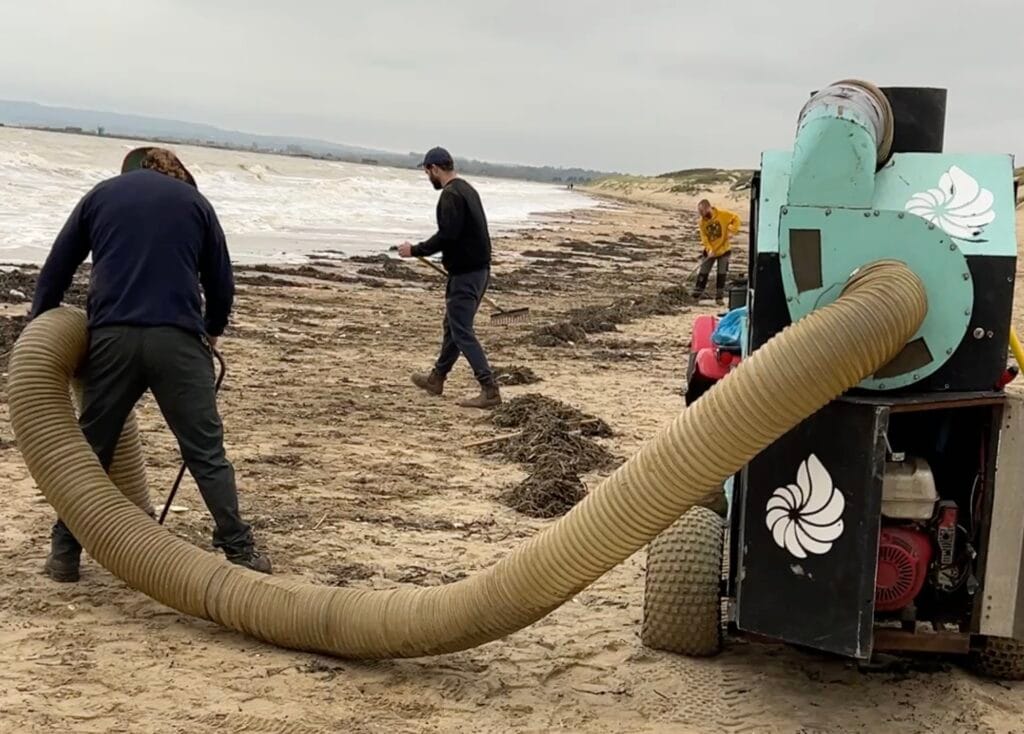
Now that Southern Water has admitted responsibility, they and Rother District Council Coastal Officers will be working on-site.
Before this admission, much of the removal had been undertaken by Nurdle, using specialist equipment, with community volunteers helping to remove them manually. However, it is impossible to remove them all. They are buried in the sand, covered by seaweed, and many are undoubtedly still in the sea, to be washed up at each high tide.
The river Rother is tidal for its first 3.7 miles (6 km). Camber Sands stretches from the eastern side of the river mouth to the Kent border and just beyond. A large section of the western end of the dunes lies within the Camber Sands and Rye Saltings Site of Special Scientific Interest, while the rest is designated a Site of Nature Conservation importance. Unfortunately, the bio-beads can enter the river and be carried upstream.
This could have a devastating effect on the Rye Harbour Nature Reserve to the west of the river mouth. They have already been found in the saltmarsh. Rye Harbour Nature Reserve is one of the largest and most important wildlife sites in England, set in an exceptional coastal and wetland landscape and home to more than 4,355 species of plants and animals including 300 that are rare or endangered. It has been designated a Site of Special Scientific Interest, A Special Protection Area, a Special Area of Conservation and a Ramsar wetland site of international significance.
Helena Dollimore, along with Sussex Wildlife Trust, has launched a campaign to end the use of plastic beads beads in wastewater treatment.
What you can do
If you see biobeads freshly washed up on your beach, please call the Environment Agency on 0800 807060 – quoting reference 2440833.
If you find a dead cetacean (whale, dolphin or porpoise) or a dead seal, please report it to CSIP on 0800 652 0333 and send a record to [email protected].
If you find a dead bird, please report it to Defra on 03459 335577 and send a record to [email protected].
Do not touch any dead animal or bird, as they may carry disease.
This is the Rother District Council link to the ongoing operation
This is the latest message from Southern Water:
“We’re continuing our clean-up operation at Camber Sands and the surrounding beaches. Since 8 November, more than 850 Southern Water staff and contractors have helped to remove beads found on the beach – alongside the amazing effort from community volunteers. We have also monitored more than 60 miles of coastline in East Sussex and Kent (from St Mary’s to Easte Cliffe and Warren Nature Reserve, and then onto Samphire Beach).
Due to a decrease in reported new bead sightings, we have stopped daily walks along the coastline and will now visit areas with new reported beads and swiftly clean the affected area.
December’s spring tide, when the tides are at the highest and lowest of the month, washed-up more beads up onto Camber Sands and surrounding areas. We were ready for this. We arranged for microplastics experts, Nurdle, to be on the beach with their specialist vacuum to remove the beads carefully from the sand and seaweed. Southern Water staff and contractors operated manual auto screeners at beaches and backpack vacuums at the Rye Nature Reserve.
Although we’ve recovered a significant number of beads, evidence suggests more beads may still be in the sea and it’s possible more will wash up during the next spring tide between 4 and 6 January.
We’re prepared for this. We’re continuing to cover all clean-up costs and working in partnership with Rother District Council and microplastic removal experts, Nurdle, to remove the beads from beaches as quickly as possible. We have paid for three new specialist microplastic vacuums to be made to support the ongoing effort. These machines will be ready to use from 5 January by Nurdle and our contractors Adler and Allan. We’ve also commissioned the build of a large towable beach screener that will act like a giant sieve to remove the top layer of sand to retrieve any beads that may be just under the surface – this will be ready late January.
We’re really grateful for the fantastic help we’ve received so far from all volunteers. Like in December, Nurdle is kindly asking for volunteers to avoid helping at the beach until further notice to allow the machinery to complete the clean-up safely and effectively. The public can continue to enjoy the beach including walking dogs and swimming in the sea.
We are asking the public to report any sightings of beads on nearby beaches via our online bead reporting tool using the What3Words of the location, along with any pictures and our teams will visit and assess the precise location.
Should we see any beaches impacted over the weekend we’ll update our website here.
We would appreciate your support in relaying this message so that the specialists can operate effectively.
Thank you for your continued support and collaboration.”
Last updated 5 January 2026